
Emergency management units
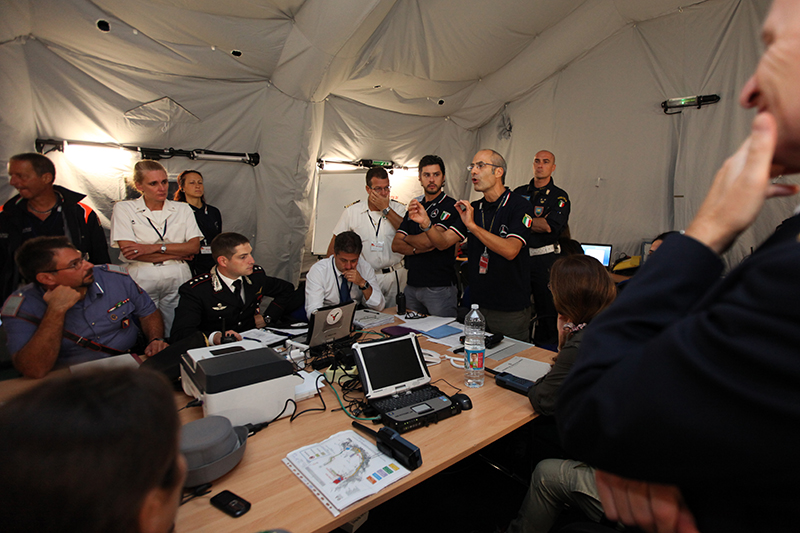
To manage the emergency and support the Deputy Commissioner, two implementing bodies are appointed and two committees are established to provide advisory and technical-scientific support. To ensure the implementation of the ship removal and recovery project, a Monitoring Observatory is also established.
During the initial phase of the emergency, while the ship is being rotated and refloated, temporary mission units are also established to provide the Deputy Commissioner with technical, operational, organizational, administrative, and logistical support.
The Deputy Commissioner is assisted by an Advisory Committee composed of the Mayor of Giglio Island, the Prefect of Grosseto, and representatives of the Region of Tuscany, the Province of Grosseto, and the Ministries of the Environment and Infrastructure and Transport. In addition, a Technical-Scientific Committee is established, comprising experts in environmental protection and ship recovery who are members of the Italian National Civil Protection Service.
The Deputy Commissioner relies on two Implementing Entities:
- Giampiero Sammuri, who is responsible for overseeing the preparation, verification, and safe implementation of the plan for managing the materials and waste on board the ship.
- Arturo Faraone, who is responsible for overseeing the preparation and verification of the plans for securing, recovering, and removing the ship, ensuring that all operations are carried out safely and with due regard for environmental protection. With regard to the transfer of the shipwreck to the Port of Genoa, the Implementing Entity verifies compliance with the requirements established by the relevant authorities at the Conference of Services held on June 25, 2014, as well as with the required technical certifications. Before the ship’s departure, the Implementing Entity obtains confirmation from the competent Maritime Authority that all requirements have been met. During the transport of the shipwreck to the Port of Genoa, the Implementing Entity oversees the transmission of information on the various activities from Costa’s Fleet Operations Center to the Operations Room of the General Command of the Italian Coast Guard and to the Italian Situation Room of the Civil Protection Department.
Established to ensure the implementation of the ship removal and recovery project, the Observatory comprises representatives of the institutions, agencies, and organizations involved in the emergency.
Participants include a representative of the Region of Tuscany, who serves as Chair, as well as representatives from the Ministry of the Environment, the Civil Protection Department, ARPAT, the Province of Grosseto, the Municipality of Giglio Island, the Ministry of the Interior, the Ministry of Infrastructure and Transport, ISPRA, the Port Authority, the Ministry of Health, and the National Institute of Health.
The Observatory ensures that any new activities are consistent with the removal project approved by the Conference of Services and that the requirements established by that body are properly applied. It also monitors the implementation and progress of the work phases outlined in the removal project. When necessary, it assists the entity responsible for the removal and the Implementing Entities in identifying any additional authorizations or exemptions that may be required. It operates in accordance with the instructions issued by the Deputy Commissioner and reports to him on the outcomes of its meetings.
Their role is to provide technical, operational, organizational, administrative, and logistical support to the Deputy Commissioner, while the Observatory’s monitoring responsibilities remain in effect. During the initial phase of the emergency, including the parbuckling and refloating operations, three temporary task forces are established by decree of the Deputy Commissioner.
For the operational management of activities related to the ship’s parbuckling, a Coordination Centre chaired by the Deputy Commissioner is established. The Coordination Centre remains operational throughout the entire parbuckling operation and is responsible for collecting and analyzing data from the Operations Control Centre; maintaining information exchange and operational coordination with local healthcare facilities; coordinating activities with the public order and safety plan; coordinating with national and international media to ensure the timely, transparent, and accurate dissemination of information; and ensuring the availability of essential services to the island’s population. The Coordination Centre uses a Situation Room to collect and manage information.
A Coordination Centre is established on Giglio Island to manage activities related to the refloating phase. The Coordination Centre assists the Deputy Commissioner in defining measures to ensure the coordinated management of activities; facilitating the effective flow of information among all state agencies and entities involved; and establishing any additional measures required to ensure public and private safety, with the support of the Italian National Civil Protection Service. The Coordination Centre remains operational until the completion of the refloating operations. It uses a Situation Room to collect and manage information and facilitate operational coordination among its units and components.
The Observatory is established to ensure the implementation of recycling and disposal operations for the shipwreck at the Port of Voltri and in the ship repair area of the Port of Genoa. It comprises a representative of the Liguria Region, who serves as Chair, as well as representatives from the Ministry of the Environment, the Civil Protection Department, ARPAL, the Province of Genoa, the City of Genoa, the Ministry of the Interior, the Ministry of Infrastructure and Transport, ISPRA, the Coast Guard, the Port Authority, Local Health Authority No. 3, the Ministry of Health, and the National Institute of Health.